
Building AgentX: A Multi-Agent AI Platform for Predictive Maintenance and Autonomous Industrial Operations
Industrial systems generate massive volumes of telemetry every second, yet many maintenance workflows remain reactive. Engineers often discover problems only after equipment fails, leading to production downtime, increased operational costs, and delayed maintenance cycles. To address this challenge, I designed AgentX, a multi-agent AI platform that combines industrial telemetry, enterprise workflow automation, and autonomous decision-making to enable predictive maintenance at scale. By integrating AI agents, real-time telemetry streams, ServiceNow workflows, and human-in-the-loop governance, AgentX transforms raw machine data into actionable maintenance insights while maintaining enterprise-grade safety and auditability. In this article, I'll walk through the architecture, design decisions, and lessons learned while building AgentX.
Building AgentX: A Multi-Agent AI Platform for Predictive Maintenance and Autonomous Industrial Operations
Summary
Industrial systems generate massive volumes of telemetry every second, yet many maintenance workflows remain reactive. Engineers often discover problems only after equipment fails, leading to production downtime, increased operational costs, and delayed maintenance cycles.
To address this challenge, I designed AgentX, a multi-agent AI platform that combines industrial telemetry, enterprise workflow automation, and autonomous decision-making to enable predictive maintenance at scale. By integrating AI agents, real-time telemetry streams, ServiceNow workflows, and human-in-the-loop governance, AgentX transforms raw machine data into actionable maintenance insights while maintaining enterprise-grade safety and auditability.
In this article, I'll walk through the architecture, design decisions, and lessons learned while building AgentX.
The Problem: Industrial Maintenance Is Still Reactive
Modern factories are filled with intelligent machines.
Robotic arms, PLCs, servo motors, and automated production lines continuously generate valuable operational data.
Despite this, maintenance workflows often look like this:
Machine Failure
      ↓
Production Stops
      ↓
Engineer Investigation
      ↓
Root Cause Analysis
      ↓
Maintenance Request
      ↓
Repair
By the time a problem is detected, downtime has already occurred.
The consequences can be significant:
- Lost production hours
- Increased maintenance costs
- Delayed deliveries
- Reduced equipment lifespan
- Increased operational risk
The challenge isn't collecting data.
The challenge is turning telemetry into timely action.
Why Traditional Predictive Maintenance Systems Fall Short
Many predictive maintenance platforms stop at analytics dashboards.
The workflow typically looks like:
Telemetry
      ↓
Dashboard
      ↓
Engineer Analysis
      ↓
Decision
While dashboards provide visibility, they still depend on human interpretation.
As industrial environments scale to thousands of assets, this approach becomes increasingly difficult to manage.
I wanted to explore a different approach:
What if AI could not only identify potential failures, but also investigate causes, coordinate workflows, and assist maintenance teams in making decisions?
That idea became the foundation of AgentX.
Introducing AgentX
AgentX is a multi-agent AI platform designed to bridge the gap between industrial telemetry and operational action.
Unlike traditional predictive maintenance solutions, AgentX doesn't simply generate alerts.
It reasons about problems, collaborates across specialized AI agents, integrates with enterprise systems, and orchestrates maintenance workflows.
Core Objectives
- Detect anomalies before failures occur
- Analyze telemetry at scale
- Generate maintenance recommendations
- Automate operational workflows
- Maintain human oversight
- Improve uptime and reliability
- Reduce operational costs
Architecture Overview
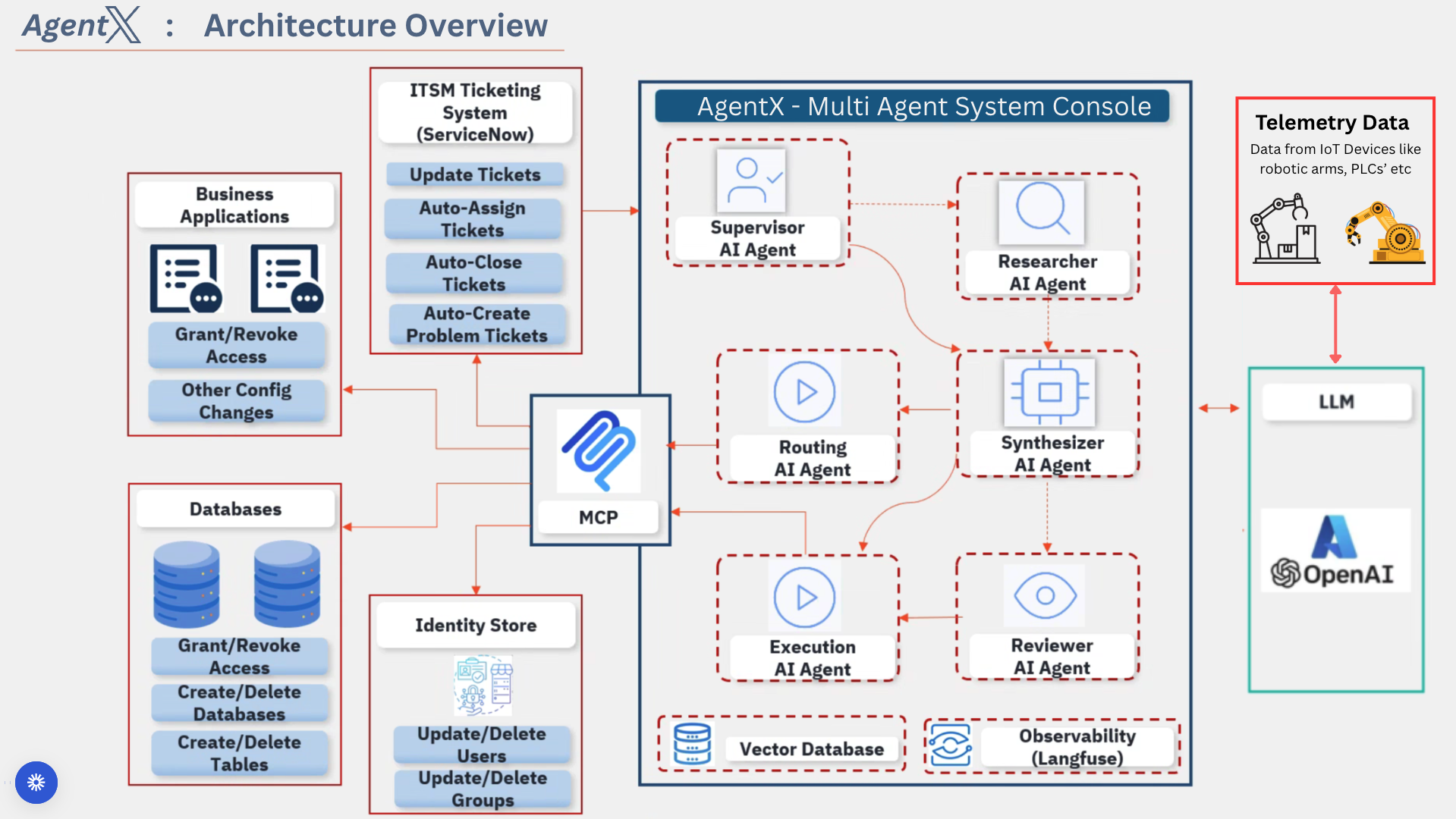
At a high level, AgentX consists of four major layers:
- Telemetry Collection Layer
- Multi-Agent Intelligence Layer
- Enterprise Integration Layer
- Governance & Observability Layer
Each layer plays a critical role in transforming telemetry into action.
Telemetry Collection Layer
Everything begins with data.
AgentX continuously ingests telemetry from industrial systems such as:
- Robotic arms
- PLCs
- Servo motors
- Industrial controllers
- Production equipment
Common telemetry signals include:
- Motor temperature
- Vibration frequency
- Power consumption
- Current draw
- Runtime metrics
- Operational cycles
- Carbon emissions
These signals form the foundation for predictive analysis.
Without reliable telemetry, even the most sophisticated AI models become ineffective.
The Multi-Agent Intelligence Layer
The heart of AgentX is its multi-agent architecture.
Rather than relying on a single AI model to perform every task, AgentX distributes responsibilities across specialized agents.
This approach improves scalability, explainability, and decision quality.
Supervisor Agent
The Supervisor Agent acts as the orchestrator.
Its responsibilities include:
- Managing workflows
- Coordinating agents
- Delegating tasks
- Monitoring execution progress
Every maintenance request begins here.
Researcher Agent
The Researcher Agent investigates incidents using available context.
It analyzes:
- Historical failures
- Maintenance records
- Similar incidents
- Operational trends
The goal is to provide deeper situational awareness before recommendations are generated.
Synthesizer Agent
The Synthesizer Agent combines:
- Telemetry data
- Historical insights
- Operational context
- Agent findings
and transforms them into actionable intelligence.
Example output:
Motor A

Temperature: Elevated
Vibration: Elevated
Current Draw: Increasing

Failure Probability: 82%

Recommended Maintenance Window:
Within 5 days
Reviewer Agent
Enterprise environments require trust.
The Reviewer Agent validates:
- Confidence scores
- Policy compliance
- Operational safety
- Recommendation quality
This layer acts as a safeguard before actions move forward.
Execution Agent
Once recommendations are approved, the Execution Agent coordinates downstream actions.
Examples include:
- Creating ServiceNow tickets
- Updating maintenance schedules
- Triggering automation workflows
- Notifying technicians
- Updating enterprise systems
This closes the loop between insight and action.
Why MCP Became the Backbone
One of the biggest challenges in enterprise AI systems is integration.
AI agents need access to multiple systems, including:
- ServiceNow
- Databases
- Identity stores
- Business applications
Instead of building custom integrations for every service, AgentX uses the Model Context Protocol (MCP) as a unified access layer.
This enables agents to interact with enterprise systems through a standardized interface.
Benefits include:
- Simplified integrations
- Improved scalability
- Reduced development effort
- Consistent security controls
MCP became the bridge connecting AI reasoning with real-world actions.
Human-in-the-Loop Governance
One of the most important design principles behind AgentX was maintaining human oversight.
Fully autonomous maintenance actions can introduce risk in production environments.
To address this, AgentX follows a human-in-the-loop model.
AI Recommendation
        ↓
ServiceNow Ticket
        ↓
Human Approval
        ↓
Execution
This approach balances automation with operational safety.
Engineers remain in control while benefiting from AI-assisted decision-making.
Observability and Auditability
Enterprise AI systems must be explainable.
Every decision made by AgentX is traceable.
Using Langfuse-based observability, the platform captures:
- Agent interactions
- Decision chains
- Prompt traces
- Telemetry lineage
- Approval history
- Execution outcomes
This provides complete visibility into how recommendations were generated and executed.
For regulated industries, this level of auditability is essential.
Sustainability by Design
An interesting extension of AgentX was incorporating sustainability metrics directly into operational workflows.
Beyond maintenance predictions, the platform tracks:
- Energy consumption
- Carbon emissions
- Equipment efficiency
- Operational waste
This enables organizations to optimize not only reliability but also environmental impact.
Future enhancements could include:
- Carbon-aware scheduling
- Energy optimization recommendations
- Digital twin simulations
- Sustainability scoring
Predictive maintenance and sustainability are more closely connected than most organizations realize.
Business Impact
One of the primary goals of AgentX was creating measurable operational outcomes.
Based on solution modeling and validation exercises, the platform demonstrated the potential to deliver:
| Metric | Impact |
|---|---|
| Mean Time To Recovery (MTTR) | Up to 80% reduction |
| Maintenance & Operational Costs | 40–60% reduction |
| Unplanned Failures | 50% reduction |
| Operational Uptime | 99.9%+ |
| Team Productivity | Up to 3x improvement |
| Carbon Footprint | 15–25% reduction |
Note: These figures represent projected outcomes derived from architecture validation, workflow simulations, and operational modeling rather than production-scale deployment metrics.
Lessons Learned
Building AgentX taught me an important lesson:
Predictive maintenance is not fundamentally an AI problem.
It's a systems engineering problem.
Successful predictive maintenance requires:
- Reliable telemetry
- Scalable event processing
- Strong governance
- Enterprise integrations
- Explainable decision-making
- Human oversight
AI amplifies these capabilities, but it cannot replace them.
The most successful systems combine intelligence with operational discipline.
What's Next?
AgentX opens the door to several exciting possibilities:
- Digital twin simulations
- Autonomous maintenance scheduling
- Multi-factory intelligence networks
- Edge AI deployments
- Reinforcement learning optimization
- Self-healing industrial systems
As industrial environments continue to evolve, the future will belong to systems capable of understanding, predicting, and acting autonomously.
Conclusion
Building AgentX reinforced my belief that the future of industrial operations lies at the intersection of AI, cloud computing, automation, and observability.
The goal isn't simply to predict failures.
The goal is to create systems that transform raw telemetry into intelligent actions while remaining transparent, governed, and trustworthy.
By combining multi-agent AI, enterprise workflows, and industrial telemetry, AgentX demonstrates how predictive maintenance can evolve from a monitoring tool into an operational intelligence platform.
And we're only scratching the surface of what's possible.